

Choose the Sagestry non-nano zinc lotion for a grass-fed tallow sunscreen in a spreadable format. Choose the non-nano zinc sun stick when you prefer a compact applicator. This 2026 guide compares their ingredients, labeled protection, and practical limits—not an unsupported ranking of the whole sunscreen market.
- The best non-nano mineral sunscreen depends on labeled protection, application, and the formula you prefer.
- Sagestry offers grass-fed tallow mineral sunscreen in a lotion and a compact sun stick, both labeled SPF 50.
- Choose the lotion for a spreadable format; choose the stick for a portable applicator.
- Zinc oxide provides sun protection. Tallow forms part of the skincare base; it does not establish SPF.
- For baby sunscreen, check age directions and the particle-size claim separately.
Why this matters
A sunscreen starts with its active ingredients. The base matters too, but it has a different job. Grass-fed tallow helps form the skincare base; zinc oxide is the sunscreen active.
Sagestry non-nano mineral sunscreen suits shoppers who want a grass-fed tallow base. That is a formula preference, not evidence that tallow provides stronger protection than another base.
For your 2026 shopping decision, separate daily application from swimming requirements. The guide to choosing tallow sunscreen for swimming covers that specific use case. A convenient format does not replace water-resistance directions.
What makes the best non-nano mineral sunscreen
Use these criteria before comparing packaging or ingredient stories:
- Sunscreen active. Read the active-ingredient panel. Zinc oxide is a mineral sunscreen active; tallow is not.
- Labeled protection. Check SPF and broad-spectrum labeling. The American Academy of Dermatology recommends broad-spectrum, water-resistant sunscreen with SPF 30 or higher.
- Particle-size statement. Look for an explicit non-nano claim. “Mineral” alone does not establish particle size.
- Formula base. Choose a base you want to wear. Grass-fed tallow is animal-derived, so a tallow formula does not fit a vegan preference.
- Application format. Compare how you will spread the product and cover exposed skin. A stick and a lotion need different application habits.
- Use directions. Check reapplication, water resistance, and age guidance on the current package.
These criteria keep the comparison grounded. Neither a short ingredient list nor a familiar ingredient replaces the sunscreen label.
Non-nano mineral sunscreens at a glance
The first two products explicitly identify non-nano zinc in their names. The baby formula is included as a separate mineral option, not ranked as a confirmed non-nano sunscreen.
| Product | Best for | Standout feature | Key limitation |
|---|---|---|---|
| Non-Nano Zinc Oxide Tallow Mineral Sunscreen SPF 50, Water Resistant, 3.4 fl oz | Shoppers who prefer a spreadable tallow formula | Grass-fed tallow, non-nano zinc oxide, SPF 50, and water-resistant labeling | Tallow is animal-derived; water-resistance directions still govern use |
| Non-Nano Zinc SPF 50 Mineral Sun Stick | Shoppers who prefer a compact applicator | Grass-fed tallow, zinc-only sunscreen active, and SPF 50 | Stick application needs deliberate coverage; check water-resistance labeling separately |
| Baby Sunscreen Sensitive Skin Protection SPF 50 | Parents comparing a mineral formula labeled for babies 6 months and older | Mineral-only SPF 50 formula with an explicit age statement | Confirm a non-nano claim separately; this is not a recommendation for younger infants |
1. Non-Nano Zinc Oxide Tallow Mineral Sunscreen: for lotion users
The Non-Nano Zinc Oxide Tallow Mineral Sunscreen SPF 50, Water Resistant, 3.4 fl oz pairs grass-fed tallow with a mineral sunscreen active. Its name identifies non-nano zinc oxide, SPF 50, and water resistance.
This is the default pick in this comparison if you want a spreadable format. The 3.4 fl oz package size tells you how much it contains, not how many applications you will get. Coverage depends on the amount applied and the area exposed.
Lotion pros
- Grass-fed tallow is explicitly identified as part of the formula.
- Non-nano zinc oxide is named rather than implied by the word “mineral.”
- SPF 50 is stated in the product name.
- Water resistance is stated, making the package directions relevant for swimming and sweating.
Lotion cons
- The animal-derived base does not suit vegan shoppers.
- “Water resistant” does not mean waterproof or remove the need to reapply.
- The ingredient description does not establish how the finish will look on your skin.
Best for: Shoppers who want a tallow-based sunscreen and prefer spreading a lotion across exposed areas.
Choose the lotion because the format suits your routine. Do not choose it on an assumption that tallow increases SPF or that non-nano zinc guarantees an invisible finish.
Verdict: Buy for a spreadable, grass-fed tallow formula with explicitly stated non-nano zinc.
2. Non-Nano Zinc SPF 50 Mineral Sun Stick: for a compact applicator
The Non-Nano Zinc SPF 50 Mineral Sun Stick | Grass-Fed Tallow | Ancient Nourishment puts the same broad ingredient preference into a different format. Its description identifies grass-fed tallow, zinc-only mineral protection, and SPF 50.
The distinction is the applicator. A stick is compact and travels without a separate spreading tool. You still need to follow its directions and cover exposed skin evenly.
Sun stick pros
- The product explicitly identifies non-nano zinc.
- Grass-fed tallow is part of the stated formula.
- The compact stick format suits a small bag or pocket.
- Zinc is identified as the only sunscreen active.
Sun stick cons
- A quick swipe is not proof of adequate coverage.
- Covering broad areas requires attention to overlapping application.
- Do not assume water resistance from the SPF number or stick format.
Best for: Shoppers who prefer a portable applicator and will take time to apply it thoroughly.
For the face, follow the product directions and avoid getting sunscreen in the eyes. Pay attention around the hairline and other areas that are easy to miss. Portability helps only when the product gets applied properly.
Verdict: Buy for the compact format; skip it if a lotion makes thorough application easier for you.
Choose between the two formats
The lotion is the default for someone who already likes spreading sunscreen by hand. The stick fits someone who values a compact applicator. Neither format earns a higher protection claim simply from its shape.
Both products identify SPF 50. That shared label does not establish identical texture, wear, water resistance, or application directions. Read each package on its own terms.


Where the baby sunscreen belongs
Baby Sunscreen Sensitive Skin Protection SPF 50 is a separate choice for parents. Its description states mineral-only protection and use for babies 6 months and older. Those are useful details, but neither confirms a non-nano particle-size claim.
Best for: Parents comparing a baby-labeled mineral sunscreen for a child within the stated age range.
Its advantage is the explicit age guidance. Its limit in this particular comparison is that “mineral-only” does not answer the non-nano question. Check that claim before choosing it specifically for particle size.
For babies younger than 6 months, ask a pediatrician about sunscreen use. FDA guidance emphasizes shade and protective clothing for this age group. For older babies, sunscreen remains one part of sun protection, alongside shade and clothing.
What each ingredient claim actually tells you
Grass-fed tallow: the base
Tallow is rendered animal fat. In skincare, it acts as an emollient, helping soften skin and forming part of the product's base. “Grass-fed” describes its sourcing, not its sunscreen strength.
Choose a tallow formula if you want that kind of base. Do not treat the ingredient as proof that a sunscreen cannot irritate skin or will suit every complexion.
Zinc oxide: the sunscreen active
Zinc oxide provides ultraviolet protection in mineral sunscreen. The finished product's labeled SPF and directions matter more than an ingredient name viewed alone.
Tallow explains the base. Zinc oxide explains the sunscreen active. Keeping those roles separate makes the comparison simpler.
Non-nano: a particle-size claim
Non-nano describes particle size. It does not describe SPF, water resistance, fragrance, or how the product feels after application. Those are separate questions.
Do not read “non-nano” as a promise of no white cast. The visible finish depends on the formula, the amount applied, and your skin tone. Judge that separately from the protection label.
The rest of the ingredient list
Read the full list if you avoid fragrance or a particular ingredient. A short description on a product page is not a substitute for the complete package label.
“Clean” is not a complete buying criterion. Your useful question is more specific: does this formula contain an ingredient you need to avoid?
How to choose your sunscreen in 2026
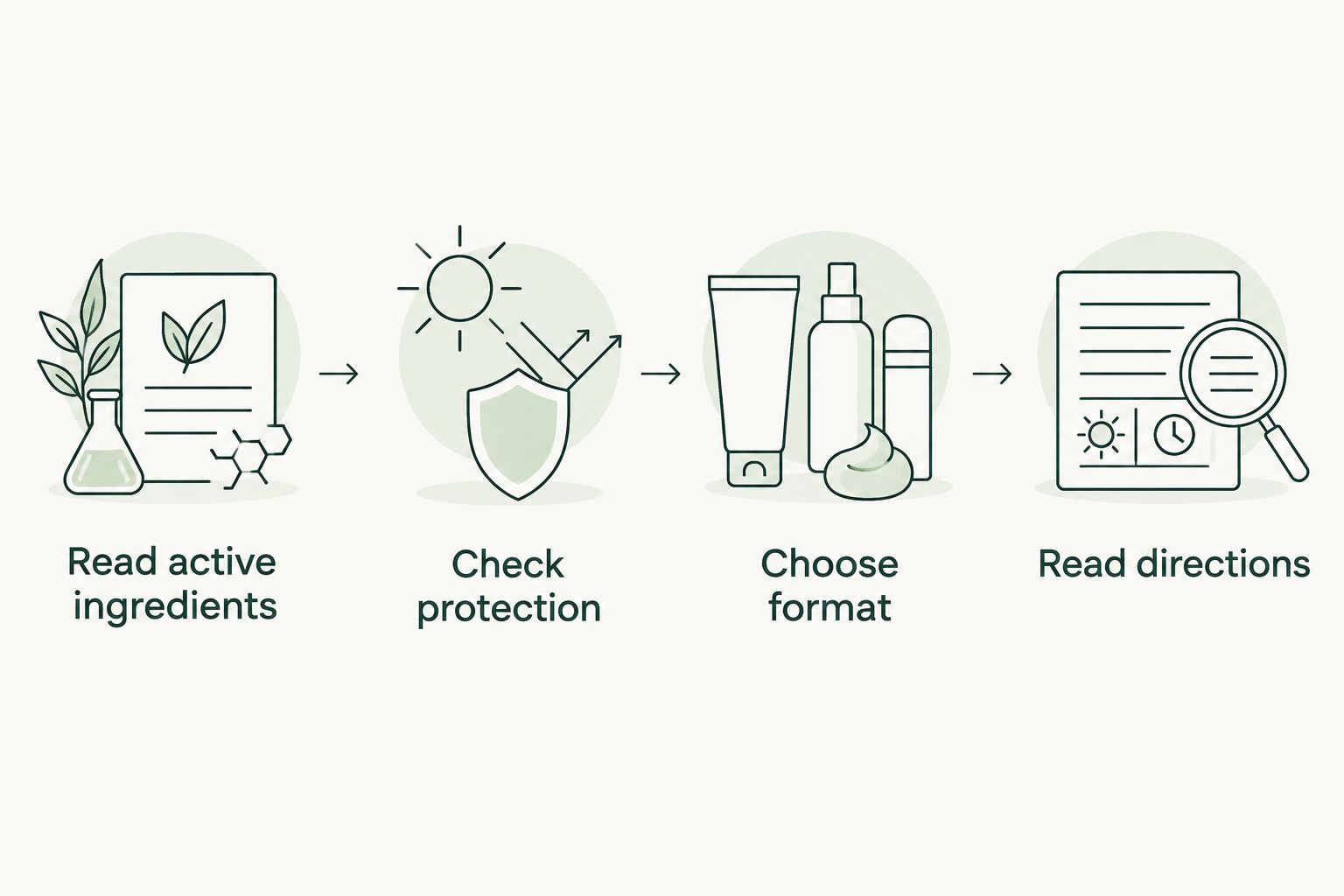
Use the same sequence each time. It keeps a preference for traditional ingredients from crowding out the protection checks.
- Read active ingredients. Identify the sunscreen active and look for the explicit non-nano statement if that is your preference.
- Check protection. Read SPF, broad-spectrum labeling, and the water-resistance statement. Treat them as separate pieces of information.
- Choose format. Pick the lotion or stick according to how you will actually apply it.
- Read directions. Check application, reapplication, water exposure, and age guidance before use.
For outdoor use, FDA guidance calls for reapplication at least every 2 hours, with additional attention after swimming or sweating according to the label. Water-resistant sunscreen labels specify 40 or 80 minutes of water resistance. Check which statement your product carries.
Do not stretch an application because the SPF number is high. SPF 50 is not a time allowance, and sunscreen does not replace shade or protective clothing.
How the 2026 picks are ranked
This Sagestry comparison ranks the two explicitly named non-nano sunscreen formats by use case. The lotion comes first for a shopper seeking a spreadable formula. The stick comes second for a shopper seeking a compact applicator.
The ranking uses stated ingredients, SPF, format, and water-resistance wording. It does not assign scores for texture, white cast, irritation, or wear. Ingredient descriptions alone cannot establish those results.
The baby formula stays outside the confirmed non-nano ranking. That distinction matters more than filling the list with another recommendation.
Which non-nano mineral sunscreen should you choose?
Choose the Non-Nano Zinc Oxide Tallow Mineral Sunscreen if you are undecided and prefer a lotion. Its stated grass-fed tallow base, non-nano zinc oxide, SPF 50, and water resistance give you clear points to check against your needs.
Choose the Non-Nano Zinc SPF 50 Mineral Sun Stick if the compact applicator is the reason you will carry and use sunscreen. Apply it deliberately rather than treating convenience as coverage.
For 2026, the useful decision is still simple: choose the labeled protection first, then the base and format you want to use. Keep the current package directions with that decision.
FAQ
What's the best non-nano mineral sunscreen if I want a tallow base?
The Non-Nano Zinc Oxide Tallow Mineral Sunscreen is the default lotion choice in this Sagestry comparison. It identifies grass-fed tallow, non-nano zinc oxide, SPF 50, and water resistance. Choose the sun stick instead if you prefer a compact applicator.
Is a non-nano sunscreen stick better than a lotion?
Neither format is automatically better. Choose a lotion if spreading it helps you cover exposed skin thoroughly; choose a stick if you prefer the applicator and will follow its application directions.
Does grass-fed tallow provide SPF protection?
Grass-fed tallow does not establish a product's SPF. In these formulas, zinc oxide is the sunscreen active and tallow is part of the skincare base. Use the finished sunscreen's labeled protection and directions.
Does non-nano zinc sunscreen leave a white cast?
A non-nano claim does not establish whether a sunscreen will leave a visible white cast. The finish depends on the complete formula, application amount, and skin tone. Do not assume an invisible finish from the particle-size claim.
Is the baby mineral sunscreen confirmed to be non-nano?
The baby sunscreen description identifies mineral-only SPF 50 protection, not a non-nano claim. Confirm particle-size wording on the current label before choosing it specifically as a non-nano sunscreen.
Can I use the baby sunscreen on a newborn?
The baby sunscreen is described for babies 6 months and older, not newborns. Ask a pediatrician about sunscreen use below that age and prioritize shade and protective clothing.
How often should I reapply mineral sunscreen?
Reapply sunscreen at least every 2 hours outdoors, following the product's directions. Swimming, sweating, and towel drying require attention to the water-resistance and reapplication instructions. A higher SPF does not remove that requirement.
Does water-resistant sunscreen mean waterproof?
Water-resistant sunscreen is not waterproof. Read the package for its stated water-resistance duration and reapply as directed. Do not transfer a water-resistance claim from a lotion to a stick simply because both have SPF 50.
One last thing
A familiar ingredient can make a formula appealing. It cannot tell you how much sunscreen to apply.
Before your first use, read the directions rather than relying on the front label. The useful sunscreen is the one you apply thoroughly and reapply as directed. Let the ingredient list guide your preference, not replace your sun-protection routine.


