

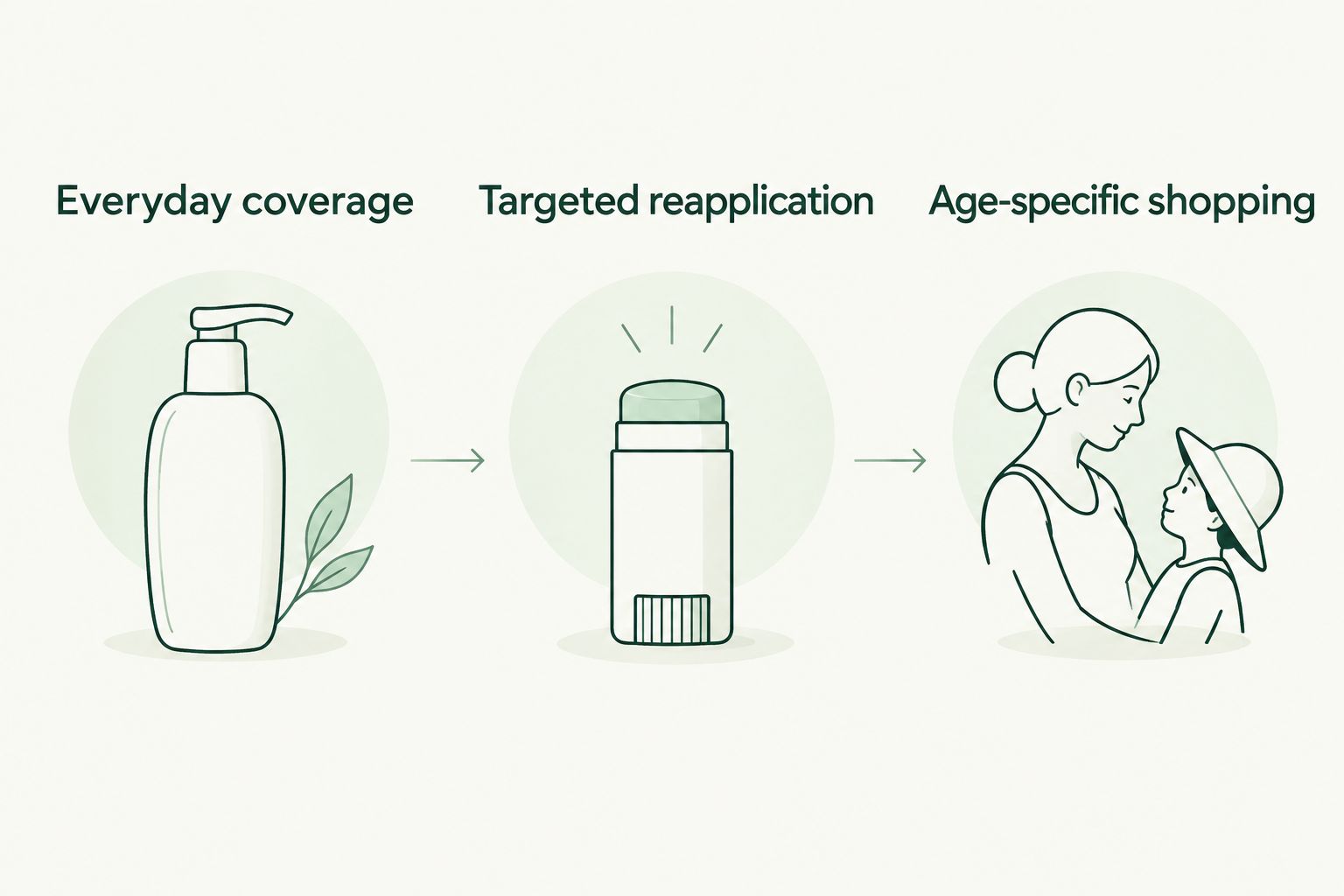
For shoppers comparing the best tallow sunscreen for sensitive skin in 2026, Sagestry’s mineral lotion is the default for everyday coverage; the sun stick suits targeted reapplication, and the baby formula serves children aged 6 months and older. These are format-based picks, not a claim that any formula prevents irritation.
- Sagestry’s mineral lotion is the default among these best tallow sunscreen for sensitive skin picks.
- Grass-fed tallow forms the base; zinc oxide provides the sunscreen protection in the lotion and stick.
- Choose the sun stick for targeted reapplication, not as a reason to apply less sunscreen.
- The baby formula is labeled for ages 6 months and older; review ingredients before choosing.
Why this matters
Sensitive skin changes the buying question. You need sun protection, but you also need to avoid ingredients that have caused trouble before. A familiar ingredient story does not answer both questions.
Sagestry offers grass-fed tallow mineral sunscreen and a baby sunscreen. For this 2026 comparison, the useful distinctions are the formula’s stated ingredients, its intended age group, and how you apply it. None establishes that one option is less irritating than another.
Choose the sunscreen by its label and your skin’s history, not by the word natural. Tallow explains the base. It does not establish SPF or guarantee comfort.
What makes the best tallow sunscreen for sensitive skin
Use these criteria before comparing formats:
- Labeled protection. Look for broad-spectrum protection and SPF 30 or higher. Check the actual package, not just the product name.
- Ingredient fit. Read the complete ingredient list against your known triggers. A short list still needs checking.
- Formula base. Grass-fed tallow serves as the lotion or stick base. It is separate from the sunscreen active ingredient.
- Application format. Choose a lotion for spreading over larger areas or a stick for controlled application to smaller areas.
- Age guidance. A baby product should state its intended age group. Adult positioning does not substitute for pediatric guidance.
- Water-resistance directions. Follow the package’s stated interval. Water resistant does not mean waterproof.
For a 2026 purchase, check the label on the product you receive. Do not assume another format has identical ingredients or directions.
Tallow sunscreen options at a glance
| Option | Best for | Standout feature | Key limitation |
|---|---|---|---|
| Non-Nano Zinc Oxide Tallow Mineral Sunscreen SPF 50, Water Resistant, 3.4 fl oz | Everyday coverage | Grass-fed tallow base with mineral SPF 50 protection | Sensitive-skin tolerance is not established by its ingredient positioning |
| Non-Nano Zinc SPF 50 Mineral Sun Stick | Targeted reapplication | Grass-fed tallow stick with zinc-only SPF 50 protection | Small-area application demands attention to complete coverage |
| Baby Sunscreen Sensitive Skin Protection SPF 50 | Age-specific shopping | Mineral-only SPF 50 formula labeled for babies 6 months and older | Baby positioning does not guarantee freedom from irritation |
The baby sunscreen belongs here as an age-specific alternative. Confirm its complete ingredient list rather than assuming it shares the lotion’s grass-fed tallow base.
1. Mineral lotion: best for everyday coverage
The Sagestry tallow sunscreen lotion combines a grass-fed tallow base with non-nano zinc oxide and labeled SPF 50 protection. Its product title also states water resistance. The lotion format is the default when you want to spread sunscreen over exposed arms, legs, and other larger areas.
Tallow has a different job from zinc oxide. Tallow supplies an emollient base that helps soften skin; zinc oxide is the sunscreen active. Neither the grass-fed description nor the non-nano description establishes how your skin will respond.
Mineral lotion pros:
- Lotion suits application across larger exposed areas.
- The product identifies grass-fed tallow as its base.
- The product states SPF 50 and water resistance.
Mineral lotion cons:
- The stated ingredients do not establish that the formula is fragrance-free or suitable for every sensitive-skin concern.
- Water resistance still requires following the package’s timing and reapplication directions.
Best for: Shoppers who want a tallow-based lotion as their main sunscreen format.
Before buying, compare the full ingredient list with sunscreen you have tolerated before. Look beyond the highlighted ingredients. A reaction to a past sunscreen does not identify the cause by itself.
Verdict: Buy if you want a lotion format and its complete ingredient list fits your known needs.
2. Mineral sun stick: best for targeted reapplication
The mineral sun stick pairs grass-fed tallow with zinc-only SPF 50 protection. Its solid format changes how you apply it, not the need for a complete layer. It is the more focused choice for smaller exposed areas.
A stick also asks you to pay attention. One quick pass is not a reliable substitute for the package directions, and covering a large area takes deliberate application. Keep the distinction between convenience and coverage clear.
Mineral sun stick pros:
- The solid format allows controlled placement on smaller areas.
- Grass-fed tallow is explicitly identified in the formula description.
- The product identifies zinc as its only sunscreen active.
Mineral sun stick cons:
- Complete coverage is harder to judge from a casual swipe.
- The supplied description does not establish a water-resistance interval.
Best for: Shoppers who prefer a stick for targeted reapplication alongside a broader sun-protection routine.
Check the directions for the required application method. Do not borrow the lotion’s water-resistance claim or assume the two products have the same supporting ingredients. Shared SPF does not make their formulas interchangeable.
Verdict: Buy for controlled application to smaller areas; skip it as a shortcut to using enough sunscreen.
3. Baby mineral sunscreen: best for age-specific shopping
The baby sunscreen is described as a mineral-only SPF 50 formula for babies 6 months and older. That age statement is its clearest distinction. It gives parents a more relevant starting point than an adult product description alone.
The available description does not establish its complete base or every supporting ingredient. Treat it as a baby sunscreen candidate, not a verified match for the tallow lotion. Read the full label before making that comparison.
Baby mineral sunscreen pros:
- The product states an intended age group of 6 months and older.
- It identifies a mineral-only sunscreen formula.
- It carries labeled SPF 50 protection.
Baby mineral sunscreen cons:
- Sensitive-skin positioning does not establish that an individual child will tolerate it.
- Its full ingredient list needs checking before calling it a tallow-based equivalent.
Best for: Parents comparing an age-labeled mineral sunscreen for a baby aged 6 months or older.
For younger infants, prioritize shade and protective clothing and ask a pediatrician about sunscreen use. A family’s existing sunscreen routine should not replace age-specific advice.
Verdict: Buy only when the age guidance and complete formula fit your child; wait for pediatric advice if they do not.
Read the ingredients by their job
A useful ingredient list tells you what each part does. It does not need a story about every ingredient being better than its alternative.
Grass-fed tallow: the base
Tallow is rendered animal fat. In skincare, it serves as an emollient ingredient that softens skin and contributes to the product’s texture. Grass-fed describes its source, not a measured level of UV protection.
A tallow base is also animal-derived. If you avoid animal ingredients, choose a different formula rather than treating the sourcing description as a minor detail.
Zinc oxide: the sunscreen active
Zinc oxide provides UV protection when used in a properly formulated sunscreen. The finished product’s labeled SPF matters; adding zinc oxide to a homemade balm does not establish an SPF.
Non-nano describes particle size. It is not an irritation rating, an allergy guarantee, or permission to apply less product.
Supporting ingredients: read the whole list
The remaining ingredients affect texture, scent, stability, and other formula functions. Their roles depend on the actual formula. Do not infer their presence or absence from a front-label claim.
If you already know a fragrance or another ingredient causes a reaction, check for it directly. The tallow base does not cancel out a known trigger elsewhere in the list.
How to choose without guessing
Start with your actual use case. Then narrow the formula. This keeps a familiar ingredient from becoming the only reason you buy.
- Choose the job. Use the lotion as the starting point for larger areas, the stick for targeted application, or the baby formula for age-specific shopping.
- Check the whole label. Confirm broad-spectrum protection, SPF, ingredients, age directions, and any water-resistance interval.
- Compare known triggers. Use your own reaction history. Do not replace it with a general claim about clean ingredients.
- Introduce cautiously. Try a small area first, following professional advice if you have a history of reactions. This does not guarantee later tolerance.
- Stop if skin reacts. Discontinue a product that causes irritation. Ask a clinician about persistent or significant symptoms.
If you have eczema, diagnosed contact allergies, or repeated sunscreen reactions, bring the ingredient list to your clinician. Choosing another natural formula without identifying the problem repeats the same uncertainty.
Apply enough, then reapply
The American Academy of Dermatology recommends broad-spectrum, water-resistant SPF 30 or higher. Its general sunscreen guidance includes application about 15 minutes before going outdoors and reapplication every 2 hours, as well as after swimming or sweating according to the label.
Most adults need about 1 ounce to cover exposed body skin. That is general guidance, not a product-specific dose for these formulas. Clothing coverage and body size affect how much exposed skin you need to cover.
For your 2026 routine, read the product’s Drug Facts and directions before the first use. Follow the stated water-resistance interval rather than assuming that SPF 50 lasts through every swim.
- Cover exposed areas deliberately, including ears and the backs of hands.
- Follow stick directions rather than relying on a single swipe.
- Use shade, clothing, and a hat alongside sunscreen.
- Treat a comfortable texture as a reason to apply consistently, not sparingly.
A formula you like still needs a complete application. Tallow does not change that rule.
How these options are ranked
This 2026 ranking uses stated product details: format, sunscreen active, labeled SPF, water-resistance wording, and age guidance. The order follows the buying criteria above, with everyday coverage first and narrower use cases after it.
The ranking does not claim measured differences in irritation, white cast, wear time, or clinical performance. Those comparisons require evidence beyond product names and descriptions.
Which tallow sunscreen should you choose?
Sagestry tallow sunscreen lotion is the default for shoppers who want a grass-fed tallow base for everyday coverage. Choose the stick when your priority is targeted application. Choose the baby formula for its stated age guidance only after checking the complete ingredients.
For sensitive skin in 2026, the deciding question is not which ingredient sounds oldest or simplest. It is whether the finished formula fits your skin and whether you will apply it correctly.
FAQ
What’s the best tallow sunscreen for sensitive skin?
Sagestry’s mineral lotion is the default in this comparison for shoppers wanting a grass-fed tallow base and a lotion format. That is a use-case recommendation, not proof that it causes less irritation than the other options.
Does tallow provide sun protection on its own?
Plain tallow does not have an established labeled SPF. Choose a formulated sunscreen with labeled protection rather than using tallow alone as sunscreen.
Is a tallow sunscreen stick better than lotion for sensitive skin?
A stick is not established as less irritating than a lotion simply because it is solid. Choose the format for the area you need to cover, then compare the complete ingredient lists.
Can I use the baby sunscreen on a newborn?
The listed baby sunscreen is intended for babies 6 months and older, not newborns. For younger infants, prioritize shade and protective clothing and ask a pediatrician about sunscreen use.
Does non-nano zinc oxide mean a sunscreen cannot irritate skin?
No. Non-nano describes particle size, not guaranteed skin tolerance. Your response depends on the finished formula and your individual sensitivities.
How often should I reapply tallow sunscreen?
General sunscreen guidance calls for reapplication every 2 hours outdoors and after swimming or sweating according to the label. Follow the product’s specific directions and water-resistance interval.
Can I make tallow sunscreen by mixing in zinc oxide?
A homemade tallow-and-zinc mixture does not have a verified SPF simply because it contains zinc oxide. Choose a finished sunscreen with labeled protection rather than guessing at its performance.
One last thing
The ingredient that gives a sunscreen its identity is not necessarily the ingredient that gives it protection. Here, tallow explains the base. Zinc oxide explains the sunscreen active.
Keep those jobs separate when you shop. It makes the label easier to read and the decision easier to make.


