

Pregnant women's magnesium deodorant is underarm care that uses magnesium compounds for odor control, with the aim of managing odor during pregnancy. This 2026 guide explains how to compare formulas, separate deodorant from antiperspirant, and assess ingredients without treating a natural label as a safety guarantee.
- Choose magnesium deodorant for pregnant women by its full ingredient list, not a pregnancy-safe slogan.
- Sagestry offers a grass-fed tallow magnesium deodorant without aluminum or baking soda; those features do not establish pregnancy safety.
- Deodorant addresses odor. Antiperspirant reduces sweating. Choose according to the job you need done.
- Check fragrance, skin tolerance, and application directions before changing your underarm routine.
Why magnesium deodorant matters for pregnant women
Pregnancy brings more label questions. You want to know what touches your skin, what each ingredient does, and whether a familiar routine needs to change. A deodorant comparison should answer those questions without turning ordinary sweating into a problem that needs fixing.
The useful distinction is simple: odor control and sweat reduction are different jobs. Magnesium deodorant belongs in the odor-control category. It is not a substitute for an antiperspirant when reducing wetness is your main goal.
Sagestry offers tallow-based skincare, including magnesium deodorant. The relevant questions are the formula's base, its other ingredients, and how your skin responds—not whether the ingredient names sound traditional.
For your 2026 shopping list, start with your current experience. A comfortable product that does its job deserves a different decision from one that causes itching, leaves unwanted residue, or fails to control odor. Pregnancy alone does not establish that your current deodorant needs replacing.
How to choose magnesium deodorant during pregnancy
1. Define the job you need done
Start with what you notice, not what an advertisement tells you to fear. Is the problem odor, damp clothing, fragrance that now feels unpleasant, or irritation after application? Each calls for a different comparison.
A deodorant helps manage underarm odor. An antiperspirant reduces perspiration. Some products combine both functions, so read the product type rather than judging the package by its shape.
You can make this distinction without buying anything. Read your current label and write down what works. That gives you a useful baseline instead of starting a new routine on assumption alone.
- For odor: compare deodorants and their complete ingredient lists.
- For wetness: check whether your current product is an antiperspirant.
- For discomfort: stop applying a product that irritates your skin.
- For scent sensitivity: separate fragrance preference from odor-control performance.
2. Read the complete ingredient list
Read the ingredient panel yourself before relying on a front-label claim. Magnesium deodorant describes an ingredient choice, not one fixed formula. Products in the category can use different bases, fragrances, and supporting ingredients.
A short ingredient list is easier to review. It does not prove that every ingredient will suit you. Likewise, aluminum-free and baking soda-free describe what a formula leaves out; neither phrase establishes pregnancy safety.
Check the exact magnesium compound rather than treating all forms as interchangeable. Ask the manufacturer to clarify anything you cannot identify. For a personal pregnancy concern, bring the complete list to your prenatal clinician rather than asking about magnesium in isolation.
- Find the full ingredient panel, not only the highlighted ingredients.
- Identify the magnesium compound and the formula's base.
- Check fragrance, essential oils, and ingredients you already avoid.
- Photograph the label for a clinician or pharmacist to review.
3. Compare the base before choosing a product
The base carries the formula across your skin. Grass-fed tallow is rendered animal fat used as an emollient: it helps soften skin and gives a product body. It is not the ingredient that turns deodorant into an antiperspirant.
The Grass-Fed Tallow Magnesium & Zinc Deodorant is described as a grass-fed tallow and shea-based deodorant without aluminum or baking soda. Shea contributes softness and texture. Magnesium compounds are used for odor control; the role of zinc depends on its specific form, so check the complete panel rather than assuming a function from the name alone.
Sagestry magnesium deodorant is best for shoppers seeking a grass-fed tallow base without aluminum or baking soda. Its limitation is equally clear: those features do not establish pregnancy safety or guarantee irritation-free use.
For a 2026 comparison, use that ingredient preference as a filter—not a medical verdict. Tallow is animal-derived, so it does not fit a vegan routine.
- Choose a tallow base if an animal-derived emollient fits your preferences.
- Compare a plant-based formula if avoiding animal ingredients matters to you.
- Read beyond the base to fragrance and odor-control ingredients.
- Keep texture preference separate from pregnancy-safety questions.
4. Introduce one change at a time
Keep the rest of your underarm routine steady when trying a different deodorant. Changing your cleanser, shaving method, and deodorant together makes it harder to identify what caused discomfort.
Follow the product's application directions. Use intact skin, and avoid applying a new formula over a rash or freshly irritated area. A small-area trial helps you check local tolerance, but it cannot establish pregnancy safety or rule out every later reaction.
You do not need to keep using a product that burns while waiting for an adjustment period to end. Persistent irritation belongs with a healthcare professional, not a stronger application or another layer of deodorant.
- Change 1 product at a time so your comparison stays useful.
- Follow the label's directions for application and use.
- Avoid broken, inflamed, or visibly irritated skin.
- Stop use if burning, itching, or a rash develops.
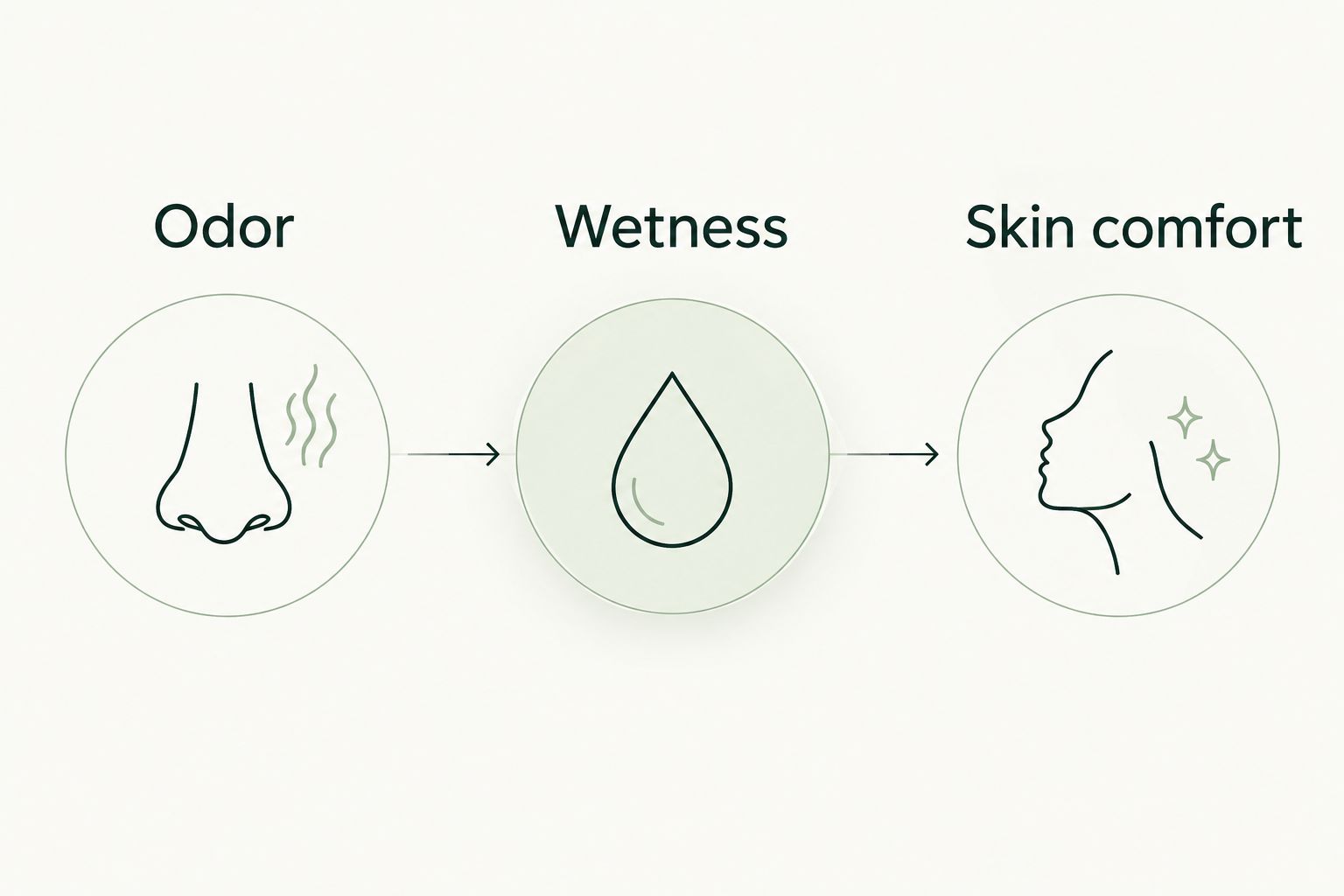
5. Judge odor, wetness, and comfort separately
A useful trial asks whether the product does the job you chose it for. Dampness does not, by itself, mean a deodorant has failed. Deodorant is not designed to stop sweating.
Keep a short note on 3 observations: odor, wetness, and skin comfort. Add whether the fragrance bothers you and whether the texture leaves residue you dislike. You are recording your experience, not trying to prove that a particular ingredient works for everyone.
Use a familiar routine for the comparison. An unusually hot outing or a different shaving routine introduces another variable. There is no reason to force a fixed trial period when your skin is uncomfortable.
- Record odor separately from dampness.
- Record wetness without expecting antiperspirant performance.
- Record skin comfort, including itching or stinging.
- Note scent and residue as practical buying considerations.
6. Bring a specific question to your prenatal clinician
A useful pregnancy question names the product, includes the full ingredient list, and explains your concern. That is more actionable than asking whether all natural deodorants are safe.
Your prenatal clinician can consider your medical history, allergies, current skin symptoms, and the exact formula. A pharmacist can also help identify ingredients. Neither conversation needs to begin with the assumption that a natural ingredient is harmless or that a conventional one is dangerous.
Bring 2 items: the label and a short description of your experience. If your question concerns a persistent rash, painful swelling, or a sudden unexplained change in sweating, ask about the symptom itself—not just which deodorant to buy.
- Share the complete ingredient panel and application directions.
- Describe any reaction and when it began.
- Mention known allergies and existing skin conditions.
- Ask whether the concern calls for a product change or medical assessment.
Compare your underarm-care options
The right 2026 choice follows your goal. Choose by function first, then ingredients and comfort. None of these categories earns a blanket pregnancy-safe label from its name alone.
| Option | Best for | Main advantage | Key limitation |
|---|---|---|---|
| Sagestry Grass-Fed Tallow Magnesium & Zinc Deodorant | Shoppers seeking a tallow base without aluminum or baking soda | Combines a grass-fed tallow and shea base with magnesium and zinc | Animal-derived; ingredient preferences do not establish pregnancy safety |
| Other magnesium deodorants | Shoppers comparing different bases and textures | Allows comparison beyond a single formula | Magnesium alone tells you little about fragrance or the complete formula |
| Fragrance-free deodorant | Shoppers who want to avoid added fragrance | Removes added fragrance from the comparison | Fragrance-free does not mean irritation-free or sweat-reducing |
| Antiperspirant | Shoppers whose main concern is wetness | Reduces sweating rather than only addressing odor | Serves a different purpose; review its complete label for personal concerns |
A formula can belong to more than one category. A magnesium deodorant can also be fragrance-free, for example. Check the label before assuming that a category name describes everything inside.
If your existing product is comfortable and effective, keep that experience in the comparison. A new ingredient story is not, on its own, a reason to replace a routine that works.
Common mistakes pregnant shoppers make
Treating aluminum-free as a pregnancy-safety verdict
Aluminum-free identifies an exclusion. It does not evaluate the rest of the formula, your skin, or your medical history. Do not use the claim as evidence that another product is unsafe during pregnancy.
Choose an aluminum-free product because it matches your preferences or intended function. Ask a clinician about a specific safety concern.
Confusing a traditional base with clinical evidence
Tallow has a long history of use in personal care. Tradition explains the ingredient's appeal; it does not establish that a finished deodorant has been studied in pregnancy.
Sagestry uses grass-fed tallow as a distinguishing formula base. Judge that feature as an ingredient choice, not proof of a medical benefit.
Expecting magnesium deodorant to stop sweat
Odor control and sweat reduction are not interchangeable. Applying more deodorant because your underarms remain damp does not change the product's purpose.
If wetness is the concern, compare products designed for that job. Do not judge a deodorant by an antiperspirant's function.
Pushing through an uncomfortable reaction
Burning and itching are reasons to stop and reassess. They are not evidence that a product is removing toxins or that your skin needs a more determined adjustment period.
Keep the affected area free of the irritating product. Seek medical advice for persistent or concerning symptoms rather than testing more formulas over irritated skin.
FAQ
Is magnesium deodorant safe to use while pregnant?
The category name alone does not establish pregnancy safety. Review the complete formula and ask your prenatal clinician about specific ingredients, allergies, or skin symptoms.
Is magnesium deodorant better than antiperspirant during pregnancy?
Neither category is automatically better during pregnancy; they do different jobs. Magnesium deodorant addresses odor, while antiperspirant reduces sweating. Choose according to your goal and review personal medical concerns with your clinician.
What does grass-fed tallow do in deodorant?
Grass-fed tallow acts as an emollient base that softens skin and gives the formula body. It is animal-derived, and its presence does not establish pregnancy safety or prevent irritation.
Does Sagestry magnesium deodorant contain baking soda?
Sagestry Grass-Fed Tallow Magnesium & Zinc Deodorant is described as baking soda-free and aluminum-free. Check the complete current ingredient panel for the rest of the formula, including any fragrance ingredients.
Can magnesium deodorant replace a magnesium supplement?
No. Deodorant is an underarm-care product, not a treatment for magnesium deficiency. Discuss supplement needs during pregnancy with your prenatal clinician rather than using deodorant as a source of magnesium.
What should I do if a new deodorant makes my underarms itch?
Stop using the product. Avoid applying it again over irritated skin, and seek medical advice if the reaction persists or concerns you.
Do I need to switch deodorants as soon as I become pregnant?
Pregnancy alone does not establish that you need to switch deodorants. Review your current label, comfort, and concerns, then ask your prenatal clinician about any specific ingredient or reaction.
One last thing
Keep a photograph of the ingredient panel, not just the product name. A front label tells you what a brand wants to highlight. The complete list is what you need for a useful comparison or a specific question at a prenatal visit.
For 2026, keep the decision small: choose the function you need, read the whole formula, and stop if your skin objects. A simple routine still needs clear boundaries.


